
How Does a Propane Backup Generator Work?
Understanding Generator Size and Capacity
 Nearly 34 million, or 1 in 4 U.S. households across the country, reported they were completely without power at least once in the 12 months before they were interviewed for the U.S. Census Bureau’s 2023 American Housing Survey.
Of these households, about 70%, or 23.6 million, reported at least one outage that lasted six hours or more. Main reasons for a power outage to occur include:
- Natural causes like severe weather and falling trees.
- Human errors, such as systems malfunctions, poor maintenance and car accidents involving electric power infrastructure.
- Grid overload issues, such as high demand for electric power during heat waves.
Propane Generators Keep Your Power On
Whole-house propane generators have grown in use because they ensure your sump pump, home security systems, heating and cooling equipment and any needed medical devices will continue to run in case of a prolonged electrical power stoppage. A smaller, portable generator is much more limited in ability compared to a whole-house model.
However, people may wonder: “how do I pick the right generator system for my home?” Another common question is: “how much propane will my generator use?” If you’ve been considering buying a whole-house generator for your New York home, here is vital information for you.
How Does a Propane Generator Work?
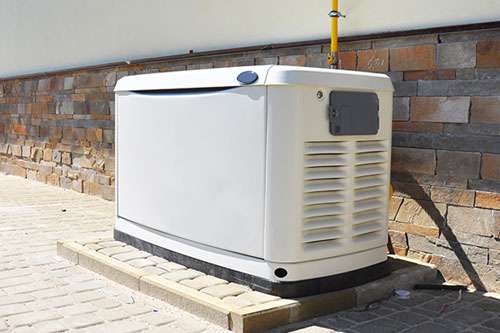
A whole-house propane generator is a permanent fixture found outside your home. It’s connected to your home’s electrical system with its own fuel source. Basically, it looks like an outdoor central air conditioning unit with a cap on it.
The generator is designed to start automatically when you lose power—usually only 10–30 seconds after an outage. After your power is restored, the generator will shut down. All this happens whether you’re at home or away.
Benefits of a Whole House Propane Generator
The biggest benefit to a whole house generator, of course, is that you’ll never be without power again! Being able to switch between the grid and generator power is a priceless convenience.
Imagine never having to suffer through the inconveniences of a power outage again – no more unexpected nights at a hotel or friend’s house, no more spoiled food, no more loss of TV, phone or computer service, no sweaty nights without your air conditioner or cold nights without heat, and no pipes bursting due to lack of heat in the house, to name just a few of the hassles—and costs—you have to deal with during an extended power outage.
Generator Size and Capacity: Choosing the Right One
The size of the generator you will need depends on two factors: the square footage of your home and what appliances you want to power during an outage. A good way to think about the “electric load” in your home is to break your usage down into two categories:
- Essentials: medical equipment, lights, refrigerator, sump pump, furnace fan, security system, TV/computers.
- High-wattage items: air conditioning, heating, clothes dryer, water heater, oven/stove.
Generators come in a range of sizes and prices; a small, easy-to-place 8-kilowatt (kW) unit, for example, can run power essentials such as lights, refrigerator, TV, and other small appliances. A large 25 kW commercial-grade generator, on the other hand, can easily run a heating or cooling system in addition to those smaller items.
How Much Propane Does a Generator Use?
Leading manufacturers say that a 22-kW generator would burn approximately two gallons per hour (gph) at a 50% electrical load and 3.6 gph at full load. A larger 38-kW unit would burn three gallons of propane per hour at half-load and 5.4 gph at full load.
This may sound confusing, but an experienced licensed electrician can help you with all these load calculations to ensure you choose a generator that can manage the desired emergency electrical power needs of your household.
Other key points to understand when researching generator fuel usage, in addition to a particular generator’s fuel consumption rate, are the characteristics of the fuel that powers that engine. One of the most important is that propane doesn’t degrade over time, which makes it an ideal stand-by power fuel.
To learn more about propane gas generators, please reach out to your New York propane company. They’ll be glad to give you expert advice. If they don’t install propane generators, they’ll most likely be able to refer you to a trusted contractor who does. And of course, they will be able to ensure you always have an adequate supply of propane to power your generator whenever you need it.